
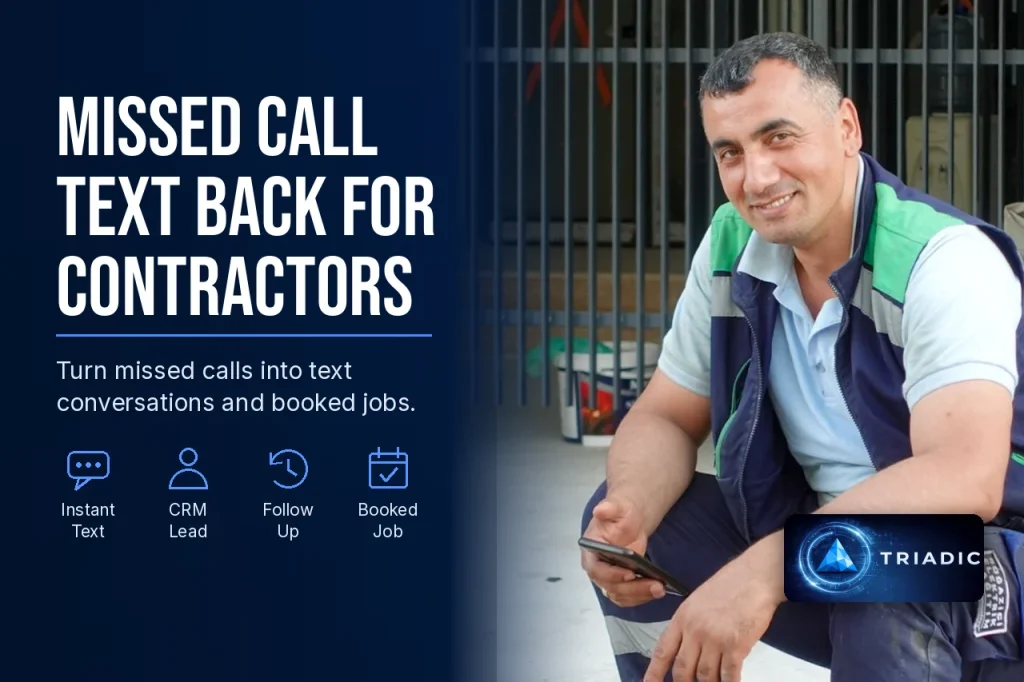
Short answer: Missed call text back is an automation that sends a text from your business number within seconds when a call goes unanswered. The caller can reply by text instead of moving on to the next contractor on their list. For roofers, plumbers, HVAC techs and other trades who can’t pick up from a ladder or under a sink, it turns a missed call into an open conversation.
It is a safety net, not a replacement for answering the phone. Here is how it works, what the first text should say, the texting rules to follow, and whether it is worth it for a small contractor in Louisville, Shelbyville or Southern Indiana.
How does missed call text back work?
The setup is nearly the same on every platform:
- A customer calls your business number and nobody answers, because you are on a job, driving, or it is after hours.
- The system notices the unanswered call, usually after a set number of rings or when it rolls to voicemail.
- A text goes out automatically from the same business number, so the customer knows who it is from.
- The customer replies, and the conversation lands in a shared inbox or CRM where you or your office can pick it up.
- If the customer doesn’t reply, an optional follow-up text can go out later.
Step 4 matters most. If replies land on one person’s phone, they get buried like voicemails. When they land in a CRM, every missed caller becomes a lead with a name, a phone number and a next step. That is how our contractor growth system is set up: calls, forms, chats and texts all end up in one place.
Why do contractors miss so many calls?
Because the work happens away from the phone. A contractor on a roof or in a crawl space often can’t answer, and a one-truck company usually has no one in the office. Plenty of homeowners won’t leave a voicemail; they just call the next company in their search results. A quick text tells them the call was noticed and gives them an easy way to keep going.
What should the first text say?
Keep it short and human. A good first text says who you are, admits you missed the call, and asks one easy question:
“Hi, this is [Your Company]. Sorry we missed your call, we’re out on a job. What can we help you with? Reply here and we’ll get right back to you.”
A few details make a real difference:
- Put your company name in the first line so the text doesn’t look like spam.
- Ask one question, such as what kind of job or the address, instead of sending a long form.
- Use a separate after-hours message that says when you’ll be back.
- If you offer emergency service, tell urgent callers how to reach the on-call number.
When is missed call text back not enough?
Text back recovers some missed calls, not all of them. It is a weak fit for:
- Emergency calls, like a burst pipe or no heat, where the customer wants a person right now
- Callers on a landline that can’t receive texts
- Jobs that need a real conversation before anyone can quote them
For those, pair text back with something that answers live: a person, call forwarding, or an AI voice agent that collects job details and hands urgent calls to you. Our AI business automation page explains how AI answering and follow-up fit together. The goal: no caller hears nothing back.
What rules apply to business texting?
In the U.S., businesses that send automated texts from a standard 10-digit phone number are expected to register through A2P 10DLC, a carrier program handled through your texting provider. Skip it and carriers can filter or block your messages, even while your software shows them as sent. Registration usually asks for your legal business name, tax ID and a short description of how you use texting.
Also keep the first text about the call the customer just made, don’t add people to marketing texts without permission, and honor STOP replies. Your texting provider can explain the consent rules for your setup.
Is missed call text back worth it for a small contractor?
Usually, yes, if your missed calls are real jobs. Do some quick math: how many calls do you miss in a normal week, how many of those are likely new customers, and what is an average job worth to you? If recovering one job a month covers the cost, it pays for itself.
It is less useful if most callers are regulars happy to wait, or if someone already answers the phone all day.
Standalone text-back tools are generally a modest monthly fee plus per-message charges; done-for-you systems that bundle a CRM, follow-up and review requests cost more. At Triadic Software, list prices for each piece are on our pricing page. For example, Business SMS is $49 a month plus usage and CRM + Automation is $49.99 a month. We’ll tell you which pieces your setup actually needs.
How does text back fit with the rest of your system?
Text back works best when it isn’t one more separate app. Connected to your website forms, chat and CRM, every lead lands in one list, follow-ups go out on schedule, and you can see which missed calls became booked jobs. Read how we handle CRM integration for small businesses, or see our guide on which CRM works best for Louisville contractors. Speed matters too: see how fast you should respond to leads for realistic response-time targets.
Want a second look at your missed-call process?
If you run a trade or service business in Louisville, Shelbyville, Shelby County or Southern Indiana and calls are slipping through, we can review your website, Google Business Profile, missed-call process and follow-up, then show you what we would fix first. Contact Triadic Software to set up a free review, with no pressure to buy anything.
Frequently asked questions
What is missed call text back?
Missed call text back is an automation that texts a caller from your business number within seconds when you can’t answer. The caller can reply by text instead of moving on to another company, and the conversation lands in your CRM or shared inbox so you can follow up as soon as you’re off the job.
Do I need A2P 10DLC registration for missed call text back?
Yes, in most cases. U.S. carriers expect businesses that send automated texts from a standard 10-digit number to register through A2P 10DLC with their texting provider. Unregistered messages can be filtered or blocked without warning. Registration typically asks for your legal business name, tax ID and a short description of how you text customers.
Can missed call text back work with my current business number?
Often, yes. Many systems work with your existing number through call forwarding, or by text-enabling a number you already use. Other setups use a new dedicated business number instead. The right option depends on your phone carrier and setup, so check with your provider before changing anything about your main line.
What should a missed call text back message say?
It should say who you are, that you missed the call, and ask one easy question. For example: “Hi, this is [Your Company]. Sorry we missed your call, we’re on a job. What can we help with?” Keep it short, put your company name first, and set a separate message for after-hours calls.
Is missed call text back the same as an AI receptionist?
No. Missed call text back sends a text after a call goes unanswered, while an AI receptionist answers the call itself, talks with the caller and collects details. Many contractors use both: a person or AI answers when possible, and text back catches the calls that still slip through, day or night.